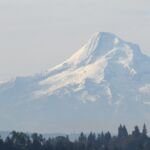
For a few years in the 1850s, nobody could say for sure whether anyone had stood on top of Mt. Hood. A Portland newspaper editor claimed the summit in 1854. Three years later, a party of five men made the climb that most historians accept as the first. By the 1890s, climbing the mountain was a summer ritual, and a club was founded on the summit itself.
Joel Palmer’s try, 1845
The first recorded attempt came from Joel Palmer, who was scouting a wagon route around the south side of the mountain with Samuel Barlow in the fall of 1845. On October 12 he climbed onto the snowfields, cut holes to get up a 40-foot wall of snow and ice, and kept going in moccasins so worn that his bare soles touched the snow. He turned back short of the top, probably a little above Illumination Rock, but he came down sure that the summit could be reached and that the south side offered the easiest way. The Palmer snowfield above Timberline Lodge carries his name, given in 1926 when it was mapped as Palmer Glacier.
Thomas Dryer’s disputed summit, 1854
In early August 1854, Thomas J. Dryer, editor of The Oregonian, set out with a party under a guide the account calls Captain Barlow. Altitude sickness turned back three of the men. Dryer kept on with Wells Lake and a Native man whose name and people the account does not record, kicking steps in the steep snow. At 2:30 in the afternoon on August 8, Dryer wrote, they reached a narrow, crescent-shaped summit ridge, where hot, sulfur-smelling gas seeped from holes between the rocks.
His account traveled east as the first ascent of a peak said to be 18,361 feet high, more than 7,000 feet too tall. Doubts came early. That October, a correspondent of the New York Times wrote that the party had reached “the top of the highest peak but one,” and put the height at about 16,000 feet. Historians now think Dryer stopped a few hundred feet short of the true summit.
The 1857 climb
On July 11, 1857, a party of five reached the summit: Henry Pittock, James Deardorff, William S. Buckley, L.J. Powell and W. Lyman Chittenden. Their climb was better documented than Dryer’s, and most historians count it as the first ascent. Pittock had come west on the Oregon Trail in 1853 and found work setting type at The Oregonian, the paper Dryer edited. In 1860 he took ownership of it in exchange for back wages and built it into a successful daily.
Crater Rock and the south side
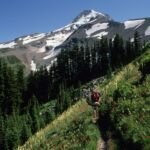
Most early climbers came up the south side, as Palmer had advised. The usual route climbs past Crater Rock, the dark lava dome left by the eruptions of the 1780s and 1790s, then passes east of it and up the Hogsback, a snow ridge below the steep final slope. Climbers soon learned the volcano was still warm. In 1883, a party of six men and four women stopped at Crater Rock on the way down to explore a large ice cave on its north side, hollowed out, they said, by the mountain’s heat. On July 5, 1914, a Mazama outing put 117 people, 40 of them women, on the summit. On the way up they rested at Crater Rock and melted snow for water beside steaming cracks in the crater wall.
A climbing culture takes hold
On the north side, Hood River settler David R. Cooper and his wife ran a tent camp below timberline from 1885 to 1889, and Cooper led climbing parties from it. Cooper Spur, Stranahan Ridge and Coe Glacier recall him and his climbing friends Oscar Stranahan and Henry Coe, who named the places for one another. On the Fourth of July 1887, William G. Steel and a small party hauled 100 pounds of red fire to the summit and lit it at 11:30 at night. People in Portland, 51 miles away, saw the glow. Newspapers called it the first night anyone had spent on top, though a climber named Perry Vickers had been reported doing the same in 1873.
Steel’s lasting mark came on July 19, 1894, when the Mazamas climbing club was founded on the summit with 105 charter members, Pittock among them. Steel Cliff is named for Steel. For more than a century, joining required climbing a glaciated peak, a rule the club dropped in 2023. Elijah Coalman, a south side guide with more than 300 ascents by 1914, helped lead that year’s climb, and the next year he helped build a fire lookout on the summit. From 1921 until 1953, a Hood River American Legion post led yearly climbs of the Cooper Spur route that drew hundreds of people without a single serious accident.
See it today
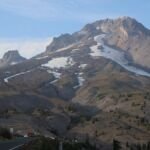
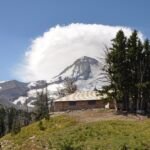
From the parking area at Timberline Lodge, the old south side route is laid out above you: the Palmer snowfield, Crater Rock in the breached crater, and the summit ridge beyond. On the north side, the Cloud Cap Trailhead and the nearby Tilly Jane area, where the American Legion camped before its climbs, sit below the Cooper Spur route. The summit itself is a serious climb, not a hike: the USGS warns of heavy rockfall above Crater Rock in summer and of avalanches and storms in winter and spring. Read our safety guide before any trip above timberline.