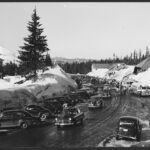
On Sunday, November 26, 1939, snow was falling at Timberline Lodge as the Magic Mile chairlift ran for the first time. Built by WPA craftsmen to a Forest Service design, it carried skiers, climbers and sightseers from near the lodge up to a stone shelter, Silcox Hut, at about 6,950 feet. Its National Register nomination calls it the second chairlift in the country and the first to stand on steel towers.
The original lift ran until 1962. The name lives on in today’s lift up the same slope, and the hut at the top has been given a new job.
A New Deal project
The Magic Mile came out of the same push that produced Timberline Lodge. The Forest Service’s regional engineering office, under supervising architect W.I. Turner, designed the lift and its two terminal buildings and oversaw the work. Dean Wright, Howard L. Gifford, Ward Gano and Linn A. Forrest worked under him. Only skilled WPA craftsmen did the building, and the whole job cost $58,000, according to the nomination.
The lower terminal stood about 200 yards east of the lodge and held the power plant. From there the cable climbed nearly 1,000 feet on towers set in concrete. At the top, the big bull wheel turned inside Silcox Hut, a squat building of local stone and hand-hewn timber finished in 1939 by many of the craftsmen who had built the lodge.
The hut is named for Ferdinand A. Silcox, who headed the Forest Service from late 1933 until he died in December 1939. He backed building lodges and other recreation buildings on national forests, and he approved the plan for a hotel on Mt. Hood in 1935. A WPA-made bronze plaque honoring him went up in the hut in 1940.
Royalty, seat belts and blankets
Before the lift was finished, it had royal visitors. On May 21, 1939, Norway’s Crown Prince Olav and Princess Martha fastened a nut and bolt on the first tower in a ceremony ahead of the dedication.
Riding the Magic Mile took some nerve. To keep skiers from tumbling out, every chair had a seat belt, and riders were handed blankets against the cold. The lift moved at 450 feet a minute and could carry about 255 people an hour. From the summer of 1940, sunset rides to the top were sold too, and a refreshment stand in the hut served visitors. The Oregonian judged the view from the hut, then billed as the Sky Hut, “one of the finest in the west.”
Second in the country?
The claim that the Magic Mile was the second chairlift in the United States comes from the nomination that put Silcox Hut on the National Register in 1985, prepared by the Friends of Timberline. The same document says that when the lift shut down it was the oldest working ski lift in the country, and that the hut marked the start of downhill ski recreation in the Northwest. Timberline’s own website once went further and called it the second chairlift in the world. We have not found an independent count that settles the ranking, so read these as claims rather than settled fact.
Retired and replaced
The original lift stopped running in 1962 and was taken apart the next year. The bull wheel came out of Silcox Hut, the lift end of the building was walled in, and for years the empty hut suffered from weather and vandals.
The lift riders use today, the Magic Mile Express, is a detachable quad chair built by Poma in 1992, according to Forest Service specifications. It climbs about 1,075 feet, from roughly 5,915 to 6,990 feet. In summer it runs as the Magic Mile Sky Ride, carrying sightseers to about 7,000 feet with views of the Palmer Snowfield and Mt. Jefferson.
Silcox Hut got a second life as well. Timberline now runs it as a small mountain lodge for overnight groups, who reach it by snowcat or SUV depending on the snowpack.
See it today
Start at Timberline Lodge & Ski Area. In summer, the Sky Ride is the easy way up, and from the top Silcox Hut is a walk of a few hundred feet. Once the snow clears, hikers can also follow trails between the lodge and the hut from the Timberline Lodge trailheads. Inside the lodge, look for old photos of the first lift, and check the Timberline Lodge weather before you go, since the upper mountain is often windy and cold.