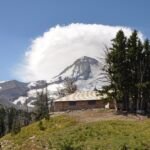
Timberline Lodge was built by hand in the middle of the Great Depression, high on Mt. Hood’s south slope at about 6,000 feet. Crews paid by the Works Progress Administration (WPA) worked on it from 1936 to 1938, and Timberline says more than 500 workers finished the job in about 18 months. President Franklin D. Roosevelt dedicated it on September 28, 1937, and it opened to guests on February 4, 1938.
The lodge was a jobs program as much as a building. Oregon architects, carvers, blacksmiths, weavers and painters shaped nearly everything in it, and their work still furnishes a working hotel and ski lodge.
Designed by the Forest Service
E.J. Griffith, who directed the WPA in Oregon, proposed the project, and the Forest Service’s regional engineering office drew the plans and ran the job. W.I. Turner was supervising architect, working with Linn A. Forrest, Dean Wright and Ward Gano. Gilbert Stanley Underwood consulted on the architecture, and landscape architect A.D. Taylor urged the builders to protect the thin volcanic ash soil and fragile alpine plants around the site.
Forrest’s 1936 drawing set the final form: a three-story, six-sided head house wrapped around a huge stone chimney, with a long wing on each side. The chimney rises 92 feet and serves six fireplaces, and the lodge’s nomination notes that the massive core was said to be meant to echo the shape of the summit. Masons built it from andesite during the winter of 1936 to 1937; Timberline puts its weight at about 800,000 pounds. Up to the first floor the walls are boulder masonry, and above that heavy timber climbs to a steep roof built to shed snow.
Made by hand
Margery Hoffman Smith, who headed the Oregon Art Project, took charge of the interiors. Ray Neufer led the wood carving and furniture making, and O.B. Dawson ran the metalwork. WPA blacksmiths worked with forge, anvil and hand tools in a Portland shop, turning old railroad rails into andirons and boot scrapers. Carvers made newel posts from discarded cedar telephone poles and topped them with beavers, bears, owls and other animals.
Fabric came from thrift as much as from looms. Weavers used Oregon flax and wool for upholstery and bedspreads, while hooked rugs and appliqued draperies were made from leftover scraps from WPA sewing rooms and from old uniforms and blankets out of Civilian Conservation Corps camps. Each guest room got its own color scheme, drawn from the wildflowers, meadows and forests of the mountain.
Painters filled the public rooms. C.S. Price, counted among the West’s first modernist painters, made The Team. Howard Sewall painted big canvases honoring the lodge’s metal and wood workers. Douglas Lynch carved and painted linoleum panels showing a calendar of mountain sports, and Virginia Darce, working with Charles Haller and Peter Ferrarin, set glass mosaics of Paul Bunyan in what is now the Blue Ox Bar.
Roosevelt’s visit
Roosevelt came up the mountain on September 28, 1937, and spoke from the lodge. He called it “a monument to the skill and faithful performance of workers” paid by the WPA, words recorded in the lodge’s National Register nomination. The Federal Theatre staged dances for the occasion with Mt. Hood as the backdrop, among them the Dance of the WPA Workers.
Hard years and a revival
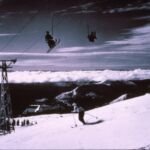
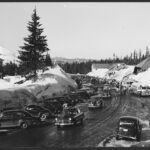
Business was good at first, but World War II emptied the lodge, and it closed in 1942. The Forest Service says it reopened in 1945 and turned its first profit in 1947. It then slid into disrepair, and in 1955 the lodge was shut again because it was being poorly run, in the Forest Service’s account.
Later in 1955, Richard L. Kohnstamm signed a lease to run Timberline and began a long rescue. His family company, R.L.K. and Company, still runs both the lodge and the ski area on a Forest Service permit. In 1975 an east wing was finished and the Friends of Timberline formed, starting with federal job training money that paid for hand-woven copies of the original fabrics. Kohnstamm died in 2006.
The lodge was listed on the National Register of Historic Places in 1973. The National Park Service records its designation as a National Historic Landmark on December 22, 1977.
See it today
Timberline Lodge sits at the top of Timberline Road, which climbs from US 26 near Government Camp. The lodge offers a self-guided art tour of its public rooms. Start at the Rachael Griffin Historic Exhibition Center on the ground floor, which shows WPA ironwork, a re-created guest room and the chair made for Roosevelt’s visit, then climb the carved stairways to the main lobby around the great chimney.
- Timberline Lodge & Ski Area: the lodge, the ski area and the summer lifts.
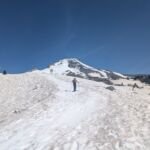
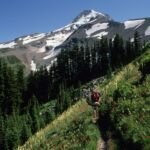
- Timberline Lodge Trailheads: the lodge stands on the Timberline Trail, which circles the mountain.
- Timberline Lodge weather: check the forecast before you drive up.