
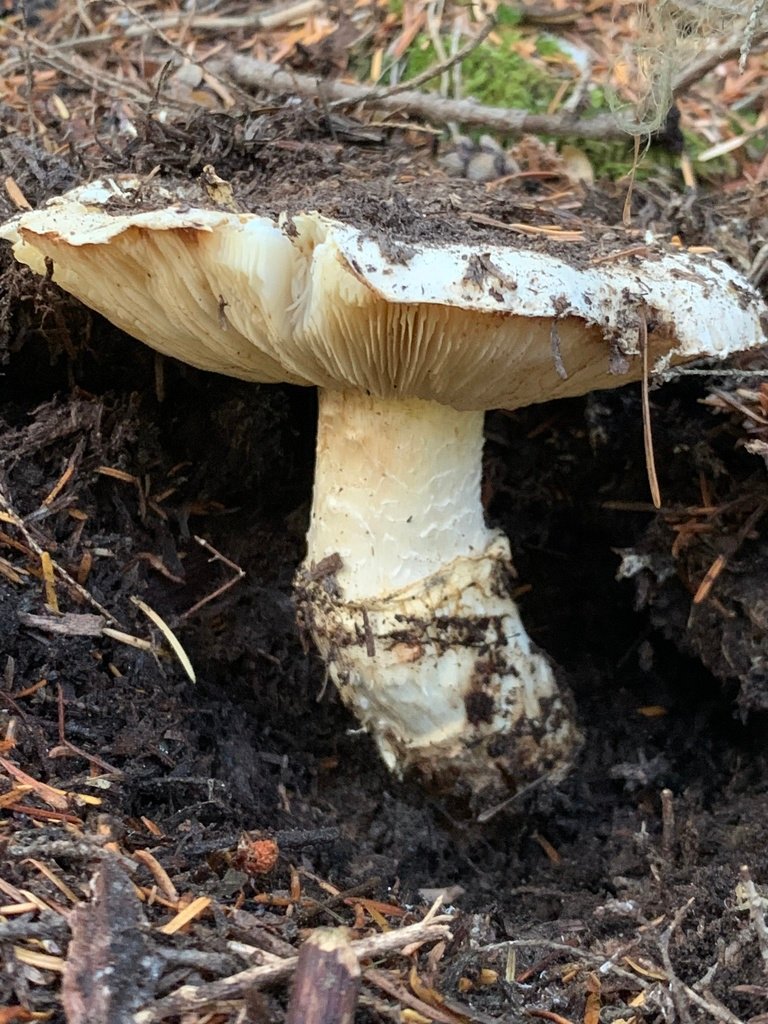
Western matsutake is a stout, firm, white mushroom of autumn conifer forests, and one with a dangerous look-alike. It was first described from Oregon and grows from the Rocky Mountains west to the Pacific coast. For years it went by the name Tricholoma magnivelare, but genetic research showed that name belongs to an eastern North American species, and the western mushroom is now Tricholoma murrillianum.
It lives in partnership with the roots of trees, mainly conifers such as lodgepole and other pines, Douglas-fir, hemlock and fir. Mushrooms appear in fall once summer heat has eased, and they often stay buried almost to the top in needle duff, showing only as a low bump on the forest floor. Young mushrooms are white and later pick up brown streaks and scales. A thick white veil covers the young gills, then collapses into a sheath around the lower stem with a flaring ring at its top. The smell is the most distinctive feature of all: strong and spicy with a slightly unpleasant edge.
Picking mushrooms on Mt. Hood National Forest has rules and closed areas, including wilderness and land near streams, so check the forest’s current guidance before picking anything.
How to identify it
Cap 2 to 4 inches across, white at first and developing brown fibers and small scales, with an inrolled edge when young. Gills white, crowded and notched where they meet the stem, with a white spore print. The firm, thick stem is white above a flaring ring and sheathed in brownish veil tissue below, and the flesh is white and firm. The odor is strong, spicy and distinctive.
Look-alikes
Smith's amanita (Amanita smithiana) is a whitish mushroom of the same conifer forests that can be mistaken for matsutake, especially after rain washes the powdery veil off its cap. Its gills are free from the stem, its ring is ragged, its stem base swells and tapers into a root-like point, and its odor is unpleasant or indistinct rather than spicy. It is dangerous; see the safety note.
Habitat
On the ground under conifers, especially pines, Douglas-fir, hemlocks and true firs, often half buried in needle duff, in fall and early winter.
Photos
Sightings in the forest
97 research-grade sightings in Mt. Hood National Forest on iNaturalist, most recently on November 7, 2026. See them on iNaturalist →