
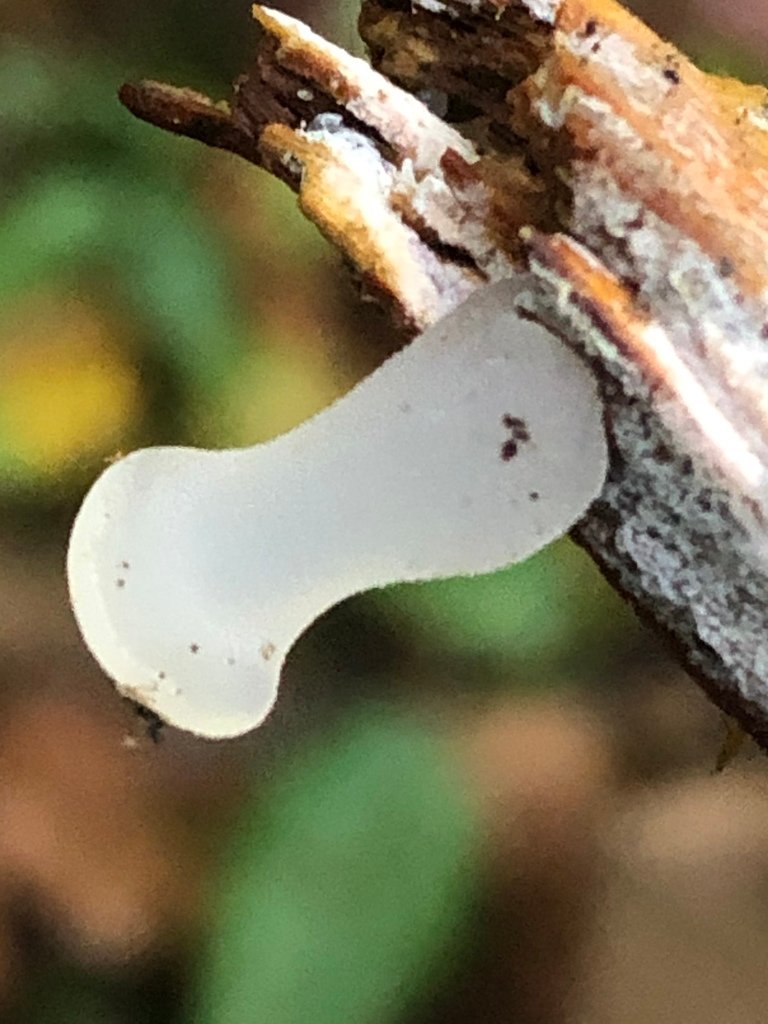
The toothed jelly fungus looks like a small, see-through tongue or fan stuck to a rotting log. Its cap is an inch or two across, translucent white to gray or brown, with a rubbery, gelatinous texture. Turn it over and the underside is covered with tiny, soft, pale spines, which is where the spores form.
Those spines make it look like a tooth fungus, but the resemblance is skin deep. True tooth fungi are firm and opaque, while this one is a jelly fungus, wobbly and translucent all the way through. The stem, when there is one, is short and attached at the side if it grows from the side of a log, or more upright when it comes up from the top of a log or from woody debris on the ground.
It lives on dead conifer wood and causes a white rot, so it plays a small part in breaking down the logs and stumps of the forest floor. It fruits in late summer and fall, and into winter where the climate is mild.
Mycologists suspect that the name covers a group of closely related species, since its color and spore size vary a great deal around the world. Look for it on wet, mossy conifer logs during the fall rains.
How to identify it
A small, gelatinous, translucent fruiting body about 1 to 2 inches across, shaped like a tongue, kidney or fan, whitish to gray or brownish. The underside bears small, soft, pale spines. The stem is short and attached at the side when it grows from the side of a log. It grows on conifer wood.
Look-alikes
Tooth fungi also have spines underneath, but they are firm and opaque, never translucent and gelatinous.
Habitat
Rotting conifer logs, stumps and woody debris in moist forest, sometimes on standing trees, alone, scattered or in clusters.
Photos
Sightings in the forest
100 research-grade sightings in Mt. Hood National Forest on iNaturalist, most recently on September 29, 2026. See them on iNaturalist →