
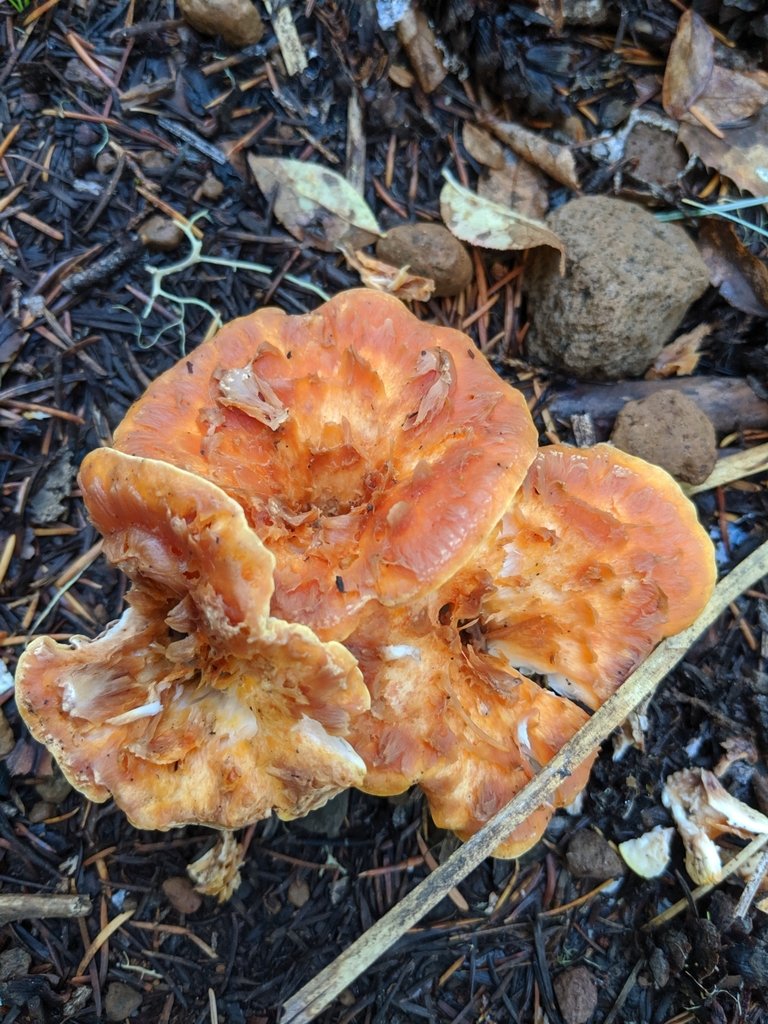
Scaly chanterelle is an eye-catching mushroom of Mt. Hood’s conifer forests: a stout orange to reddish orange vase or trumpet rising from the forest floor, its top broken into soft, shingled scales. Despite the name, it is not a true chanterelle and is not closely related to one. For years it was known as Gomphus floccosus, until research moved it to the genus Turbinellus.
Its shape is the best clue. The top sinks into a deep central hollow, so a mature mushroom looks like a scaly cone or vase, and the stem is hollow too. The underside has no true gills; instead it is covered in shallow wrinkles and forked folds that run far down the stem, cream when fresh and browning with age. The orange color can fade after heavy rain.
Scaly chanterelle is mycorrhizal, which means it lives in partnership with the roots of trees, here conifers such as pines, spruces, firs and hemlocks. It grows alone, scattered or in groups on the ground beneath them, from summer into fall. Its color makes it easy to spot against brown needle duff, and it is a good one to photograph and leave in place.
How to identify it
A fleshy, vase- or trumpet-shaped mushroom about 2.5 to 5.5 inches tall and 1.5 to 4.5 inches across. The top is orange to reddish orange and covered in soft, flattened scales, with a deep central depression; the stem is hollow. The underside has shallow, forked, cross-veined wrinkles instead of true gills, creamy at first and browning with age, and they run far down the stem.
Look-alikes
True chanterelles have a similar shape and color, but the scaly chanterelle's heavily scaled top and hollow center set it apart. Turbinellus kauffmanii is a larger scaly relative that is buff-brown rather than orange.
Habitat
On the ground under conifers such as hemlocks, firs, spruces and pines, alone or in groups, from summer into fall.
Photos
Sightings in the forest
169 research-grade sightings in Mt. Hood National Forest on iNaturalist, most recently on November 16, 2026. See them on iNaturalist →