
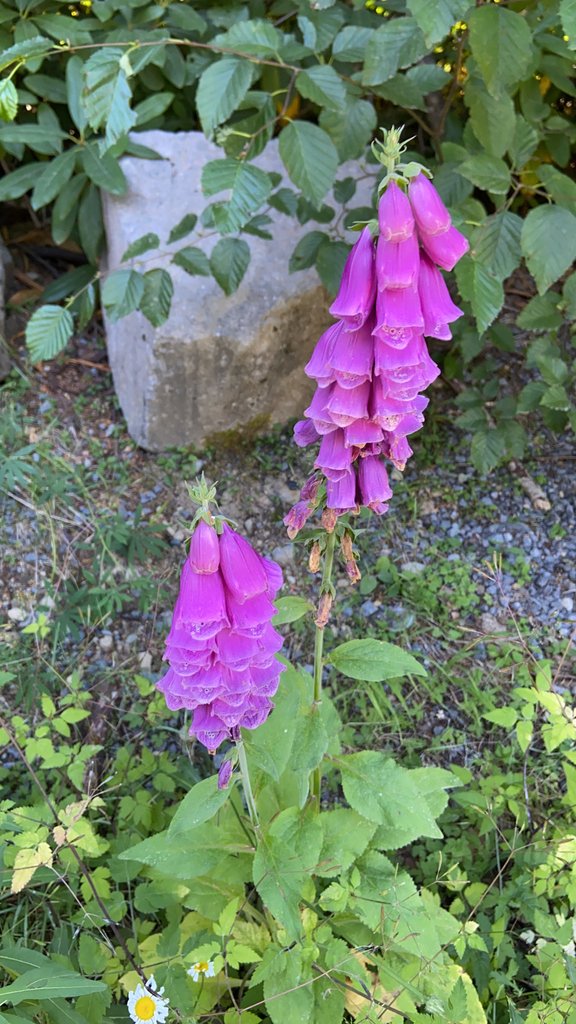
Purple foxglove is not native to Oregon. It comes from western Europe and nearby North Africa, and it has spread widely in the Northwest, where it now grows on roadsides, in fields and along forest edges. In its first year it forms only a rosette of large, soft, finely hairy leaves. In the second year it sends up a single stalk, sometimes as tall as a person, lined on one side with drooping, tubular flowers in pink to purple. The paler lower side of each flower is dotted with dark spots.
Bumblebees and hummingbirds come to the flowers for nectar, and each plant sets capsules packed with tiny seeds. Every part of foxglove contains cardiac glycosides, compounds that upset the rhythm of the heart, so the plant is dangerous to people, dogs, cats and horses that swallow any of it. It does not cause a skin rash, but it should never be tasted.
Around Mt. Hood, foxglove turns up at low to moderate elevations along roads, in clearings, at forest edges and in meadows, especially west of the Cascade crest. It blooms from late spring through summer. Enjoy it with your eyes, and keep children and pets away from it.
How to identify it
A biennial 0.5 to 1.8 m tall. The first year it is a rosette of large, soft, toothed leaves; the second year it sends up an unbranched spike. Flowers are 4 to 6 cm long, pink to purple (sometimes white), tubular and drooping, mostly on one side of the stalk, with dark spots inside on the paler lower side.
Look-alikes
Before it flowers, the leafy rosette can be confused with herbs such as borage; in one reported poisoning, young foxglove leaves were mistaken for borage and used in a sauce.
Habitat
Roadsides, fields, meadows, forest edges and other disturbed, sunny to partly shaded ground at low to moderate elevations, mostly west of the Cascade crest.
Photos
Sightings in the forest
366 research-grade sightings in Mt. Hood National Forest on iNaturalist, most recently on October 24, 2026. See them on iNaturalist →