
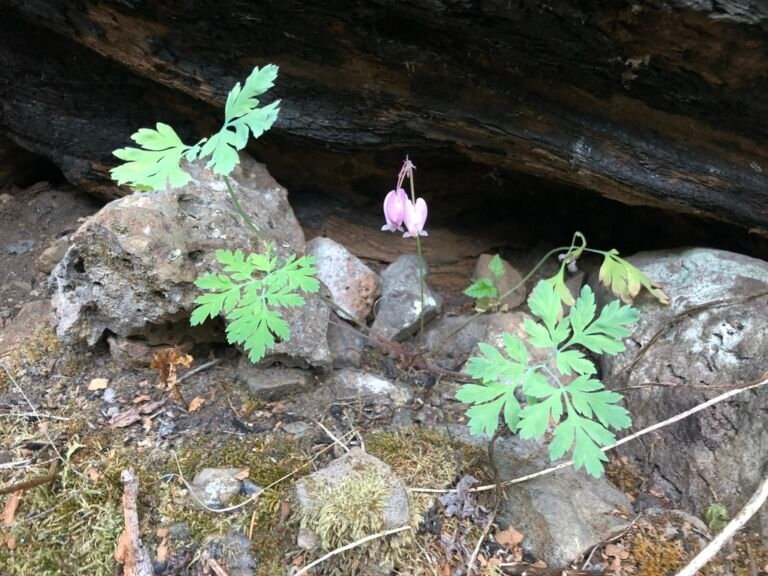
Pacific bleeding heart is a low woodland wildflower with soft, fernlike leaves and drooping clusters of rose-pink, heart-shaped flowers. It grows in moist, shady forest and along streambanks from low elevations to the middle slopes of the mountains, and it is one of the easier spring flowers to recognize along damp trails on Mt. Hood.
The genus name Dicentra means two spurs. It refers to the two outer petals, which swell into small pouches at the base of each flower and bend back at their tips, giving the blossom its heart shape. The plant spreads from brittle underground stems and also seeds itself, so it usually grows in loose colonies rather than alone. Bees and hummingbirds visit the flowers, and the bloom season is long, starting in early spring and running into summer. After flowering, many plants die back and rest through the warm months, and some send up a fresh set of leaves in autumn.
The leaves all rise straight from the ground on long stalks and have a slightly bluish cast, which helps you spot a patch even when nothing is in bloom. Admire it without picking or tasting: every part of the plant contains alkaloids that are poisonous if eaten.
How to identify it
Leaves all grow from the base on long stalks and are divided again and again into narrow segments, fernlike and often bluish green. Leafless stalks 6 to 18 inches tall carry drooping clusters of about 5 to 15 flowers. Each flower is rose-purple to pink, flattened and heart-shaped, with two outer petals pouched at the base and bent back at the tips. Narrow pods hold black seeds.
Look-alikes
Steer's head, a much smaller relative, is often only about an inch tall and carries a single flower shaped like a steer's head, usually at higher elevations. Pacific bleeding heart is much larger and has several flowers on each stalk.
Habitat
Moist, shady forests, woodland edges and streambanks, from low elevations to the middle slopes of the mountains.
Photos
Sightings in the forest
749 research-grade sightings in Mt. Hood National Forest on iNaturalist, most recently on September 5, 2026. See them on iNaturalist →