
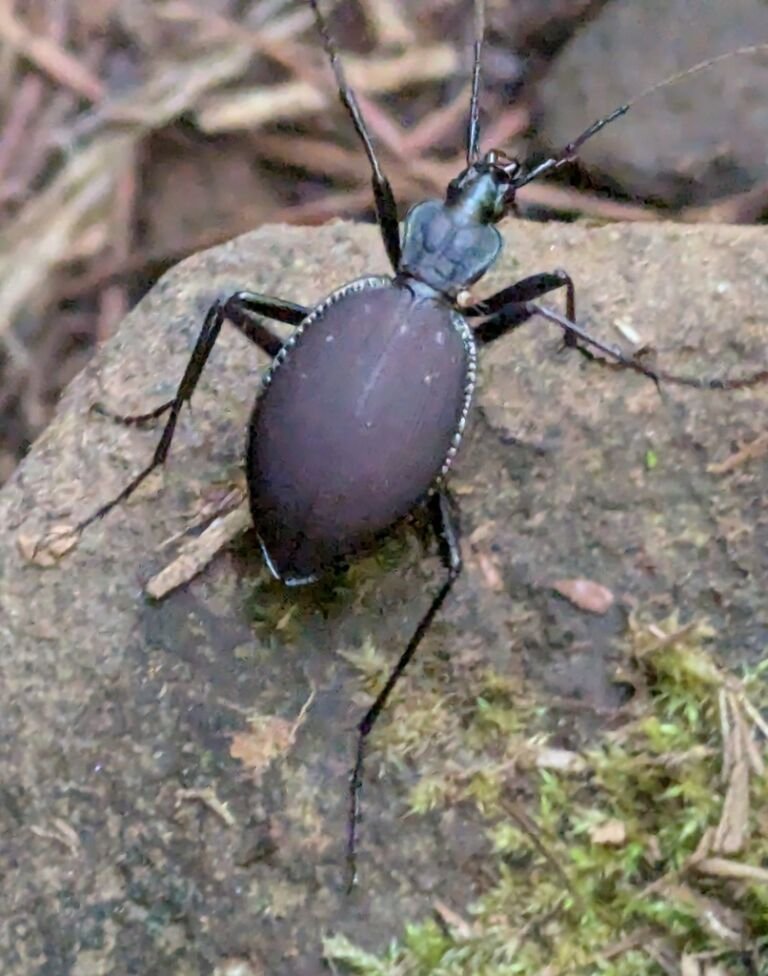
The narrow-collared snail-eating beetle is a large ground beetle of Northwest forests that specializes in eating snails and slugs. It belongs to Scaphinotus, a North American genus of snail-eating beetles whose members have a body suited to this unusual diet: a long, narrow head with well-developed mouthparts, and long legs.
That shape lets the beetle push its head up into a snail’s shell to reach the animal inside, while its long legs hold the rest of its body back from the snail’s sticky mucus. Few other insects can use snails as food this way, which gives these beetles a supply that most of their neighbors cannot reach. They catch and eat their prey alive.
Snail-eating beetles hunt at night and spend the day hidden under rocks and logs, so most people meet one by lifting a log or by spotting one with a flashlight on an evening walk. They are harmless to people. A museum specimen collected in 1989 in the Columbia River Gorge part of Mt. Hood National Forest confirms that this species lives in the forest. If you lift a log or rock to look underneath, set it back gently afterward.
How to identify it
A relatively large ground beetle with a long, narrow head, prominent mouthparts and long legs. As the name suggests, the section just behind the head is narrow. It is active on the ground at night.
Look-alikes
Other snail-eating beetles in the genus Scaphinotus share the long head and long legs, and telling the species apart takes a close look at a specimen.
Habitat
On the forest floor, hiding by day under rocks, logs and other cover and hunting snails and slugs at night.
Photos
Sightings in the forest
151 research-grade sightings in Mt. Hood National Forest on iNaturalist, most recently on October 17, 2026. See them on iNaturalist →