
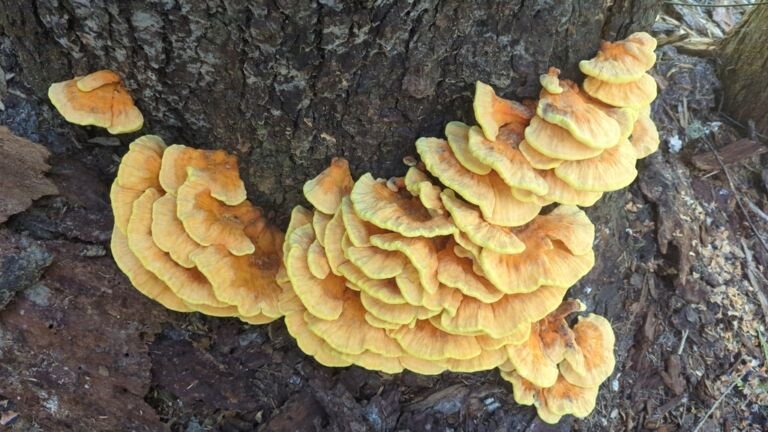
Few fungi are as easy to see from the trail as this one. Conifer chicken of the woods grows as stacked, overlapping shelves on conifers, bright orange to salmon orange on top and lemon yellow to creamy yellow underneath, where the surface is covered in tiny pores instead of gills. The flesh is pale yellow, and a big cluster on one tree can weigh 30 pounds or more.
It is a wood-rotting fungus. Sulphur shelves live inside the heartwood of living trees, often in the butt or roots, and break the wood down into a reddish-brown, crumbly brown rot. They also fruit on dead trees, stumps and fallen logs, so a bright orange shelf on an old conifer stump is a common sight.
Until 2001, this mushroom was lumped with the sulphur shelf of eastern North America, Laetiporus sulphureus. That year mycologists split the western sulphur shelves into two species: this one on conifers, and Laetiporus gilbertsonii on hardwoods such as oaks and eucalyptus. On Mt. Hood, a sulphur shelf growing from conifer wood is almost certainly this species. It ranges from California north to Alaska’s Kenai Peninsula.
Fresh shelves appear from late summer into fall. Old ones fade to white and turn chalky and crumbly, and they can stay on the wood through the winter.
How to identify it
Overlapping, fan-shaped shelves growing directly from conifer wood, bright orange to salmon orange on top, with a lemon-yellow to creamy yellow pore surface beneath and pale yellow flesh. No gills. Old specimens fade to white and become chalky and crumbly.
Look-alikes
Laetiporus gilbertsonii is nearly identical but grows on hardwoods, mainly oak and eucalyptus, and is a paler salmon to pinkish orange. Faded, overwintered shelves of either species turn white and can be hard to recognize.
Habitat
On living, dying and dead conifers, stumps and logs, often low on the trunk or near the base. Found across western North America from the Rocky Mountains to the coast, and from California to Alaska.
Photos
Sightings in the forest
106 research-grade sightings in Mt. Hood National Forest on iNaturalist, most recently on October 2, 2026. See them on iNaturalist →