
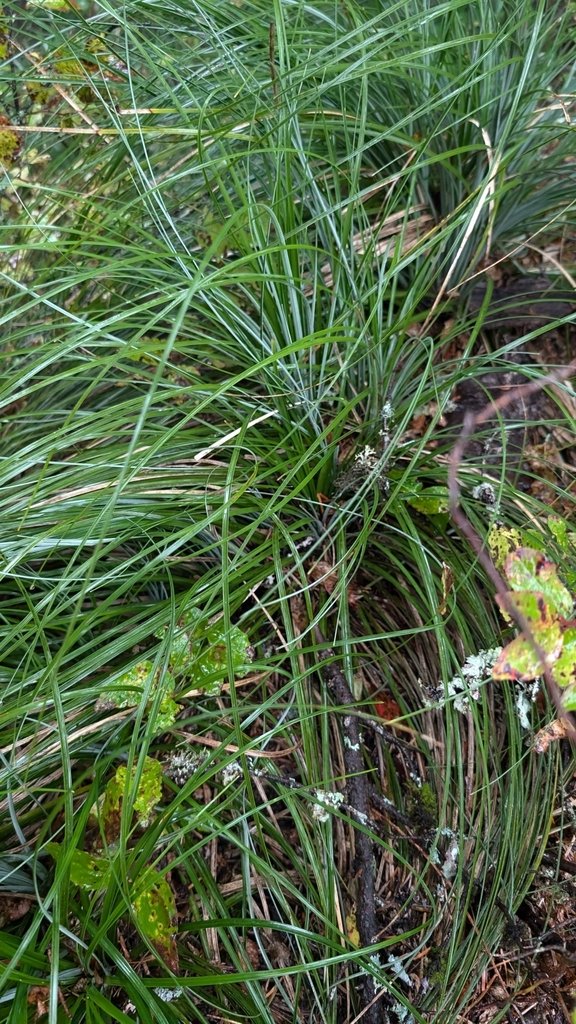
Beargrass is not a grass at all. It is a native perennial that grows in dense clumps of tough, wiry, evergreen leaves from a short woody rhizome. When it blooms, a single leafy stalk shoots up several feet and ends in a club of small cream-white, faintly fragrant flowers, so a slope in full flower looks dotted with torches.
Each leafy rosette flowers only once and dies after setting seed, but by then it has sent out side shoots that keep the clump going. A plant can go several years without blooming. The old story that it flowers every seven years is a myth. Big bloom years follow springs with good rain and soil moisture, which is why two heavy years in a row are rare.
Elk and deer eat the flower stalks, and the thick mats give pocket gophers and other small rodents places to feed. Bears do not eat it, though grizzlies have been known to line winter dens with the leaves. Native weavers have long used the strong leaves in baskets and favor leaves from the first year after a fire. Beargrass usually survives light fires by resprouting from its rhizome.
Look for it on open slopes, ridges and clearings, blooming from late spring at lower elevations into summer up high.
How to identify it
Dense clumps of long, tough, grass-like leaves with rough edges that stay green all year. In bloom, a single leafy stalk about 4 to 6 feet tall ends in a dense, rounded to elongated cluster of small cream-white flowers, each with six tepals. Dry stalks and three-lobed seed capsules often stand among the clumps after flowering.
Habitat
Open conifer woods, clearings, dry ridges and rocky slopes, from near sea level to over 6,600 feet. In the Oregon Cascades it can dominate cold, dry ridges and summits at roughly 4,700 to 5,800 feet, where soils are soggy in spring and very dry by late summer.
Photos
Sightings in the forest
1,041 research-grade sightings in Mt. Hood National Forest on iNaturalist, most recently on October 19, 2026. See them on iNaturalist →