
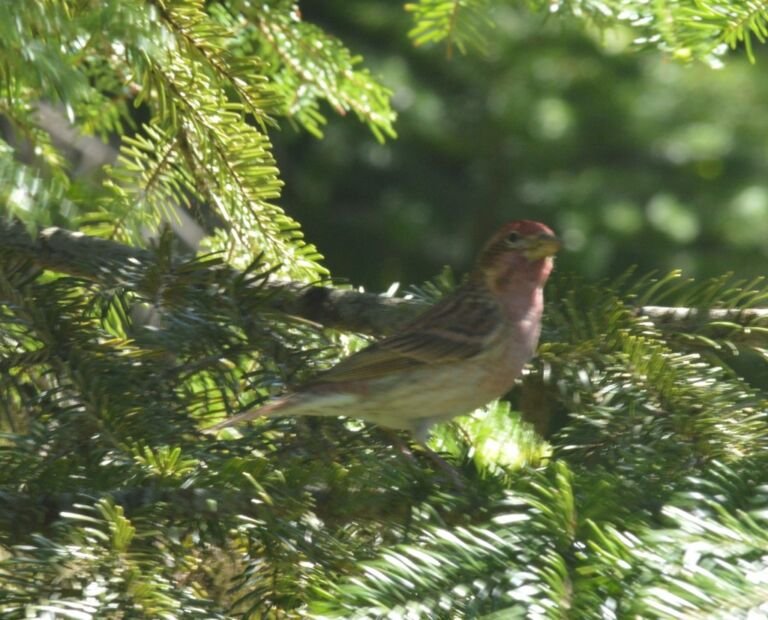
Cassin’s Finch is a finch of the high mountains. Males are washed in red on the head, throat, breast and rump, with a brighter, sharply set-off red cap and a browner nape, back and wings. Females and young males are brownish olive above with crisp dark streaks on whitish underparts, a pale line over the eye and often a faint eye ring.
It lives mostly in mountain conifer forest and often climbs to the highest forests near treeline, especially in late summer. Buds are a staple, along with conifer seeds, other seeds and berries, plus some insects in summer. It feeds high in trees, in weedy patches and on the ground, usually in small flocks outside the nesting season.
Males sing a rich, varied warble that often includes short bits borrowed from other birds. Pairs nest in large conifers, sometimes in loose colonies. Because the species wanders, numbers in any one place can rise and fall from year to year.
In winter many move down to lower mountain forests and valleys, and some years they appear in the lowlands. Survey data suggest the population has declined in recent decades.
How to identify it
Males have a bright red crown that contrasts with a browner nape, a pinkish red face, throat and breast, and faint streaks on the flanks. Females are brownish olive above and whitish below with sharp, fine dark streaks, a pale eyebrow and often a pale eye ring. Both sexes have dark streaks under the tail.
Look-alikes
Purple Finch is very similar but slightly smaller with a shorter bill, and females have a bolder face pattern and blurrier streaks than female Cassin's. House Finch usually lives at lower elevations than Cassin's Finch.
Habitat
Open mountain conifer forest of fir, spruce, pine and Douglas-fir, often up to treeline in late summer. In winter it moves to lower forests and sometimes to valley woodlands.
Photos
Sightings in the forest
87 research-grade sightings in Mt. Hood National Forest on iNaturalist, most recently on October 20, 2026. See them on iNaturalist →