
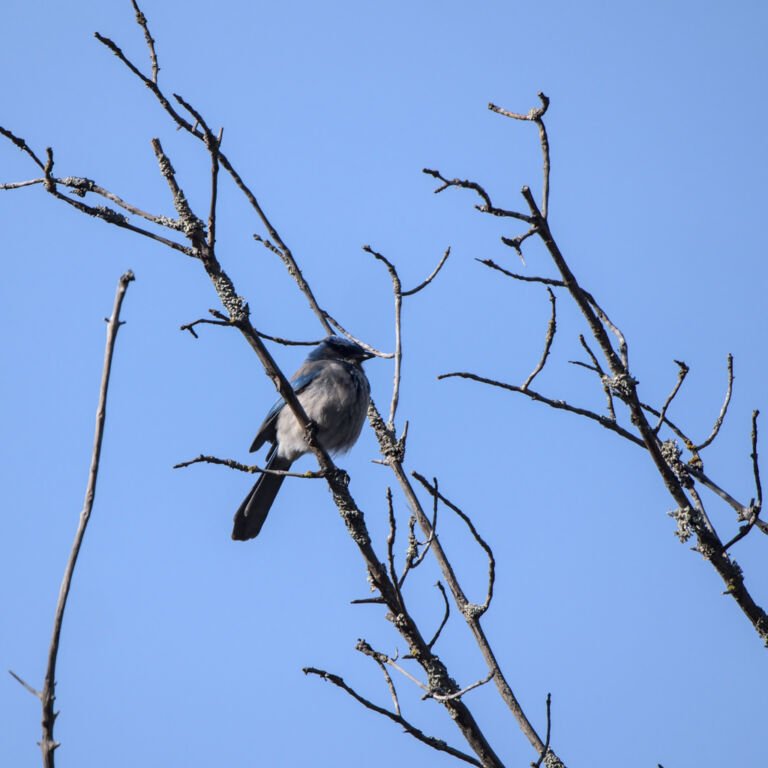
The California Scrub-Jay is the bold, noisy blue jay of yards, parks and oak woods. Unlike the Steller’s Jay of dense conifer forest, it has no crest. Its head, wings and long tail are bright blue, its back is grayish brown, and its white throat is framed by a partial blue necklace. Pairs often sail across open ground, calling loudly and harshly.
Until 2016 it was lumped with the Woodhouse’s Scrub-Jay of the interior West as one species, the Western Scrub-Jay. It eats almost anything: insects, spiders and snails in summer, and acorns, seeds and berries in winter, plus the odd egg, nestling, lizard or mouse. It also stores food, burying acorns and other finds to dig up later.
Pairs stay together all year on a permanent territory and do not migrate. The species has been spreading north since the 1970s, helped by towns and bird feeders, and its breeding range has pushed up and down the Columbia River from the Portland area. Around Mt. Hood, look for it at the lower, drier edges of the forest, in oak woodland, brushy clearings and near homes, rather than high on the mountain.
How to identify it
A slim, long-tailed jay 11 to 13 inches long with no crest. Head, wings and tail are blue, the back is grayish brown, and the white throat is bordered by a blue breast band. A thin white line runs above the eye. Calls are loud and harsh.
Look-alikes
Steller's Jay, the dark jay of dense conifer forest, has a tall, shaggy crest and a black head and chest, while the scrub-jay has a smooth blue head and a white throat.
Habitat
Oak woodland, oak scrub, streamside woods, foothill forest, and well-wooded towns and parks. It stays at lower elevations all year.
Photos
Sightings in the forest
169 research-grade sightings in Mt. Hood National Forest on iNaturalist, most recently on October 31, 2026. See them on iNaturalist →