
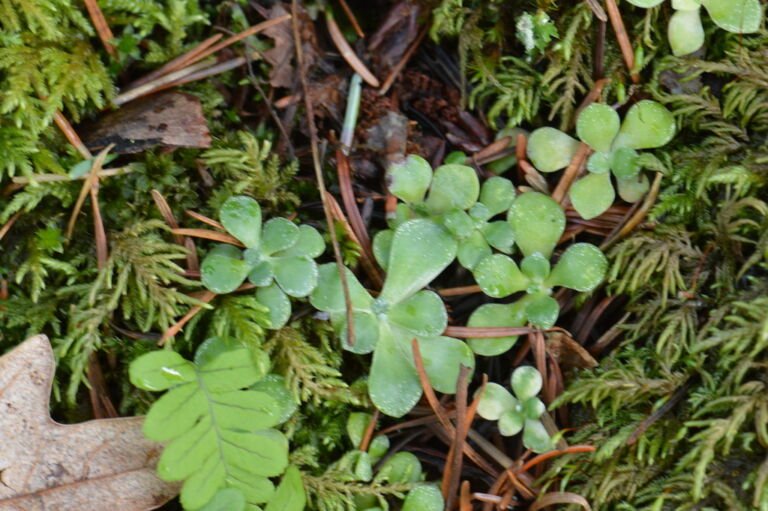
Broad-leaved stonecrop is a small succulent that turns bare rock into a garden. It spreads from stout underground stems into mats of tight rosettes, each made of thick, flattened, spoon-shaped leaves crowded together. The leaves are pale green and coated with a waxy, powdery bloom that gives them a frosted look, and in full sun they often blush red.
In late spring and early summer, short leafy stems rise from the rosettes, each topped with a flat cluster of bright yellow flowers. Every flower has narrow, spreading petals that give it a starry look, and bees and flies come to feed on them. Once a flower is done it forms five small pods that spread apart as they ripen.
This plant grows where soil is thin or missing: on cliffs, rock ledges, rocky balds, gravelly ground and openings in the forest. It favors rock that stays at least a little moist rather than the driest, hottest faces. Around Mt. Hood, look for its frosted rosettes on rock outcrops and cliffs in the foothills and lower mountain forests, often tucked among moss. It is native from southern British Columbia to California, and it is worth enjoying from the trail rather than stepping on the thin mats.
How to identify it
Look for low mats of rosettes with fleshy, flattened, spoon-shaped leaves under an inch long, pale green and frosted with a whitish bloom, often reddish in sun. Flowering stems about 2 to 8 inches tall carry flat-topped clusters of bright yellow flowers with five narrow petals.
Look-alikes
Oregon stonecrop grows on similar rocky sites and reaches higher into the subalpine; its leaves are narrower and its petals longer and drawn out into sharp points. Spreading stonecrop of rocky mid and high elevations has small, oval leaves set in opposite pairs rather than one at a time.
Habitat
Cliffs, rock ledges, rocky balds, forest openings and gravelly soil in the foothills and lower mountain forests, mostly on moderately moist rock. Its range runs from southern British Columbia to California.
Photos
Sightings in the forest
631 research-grade sightings in Mt. Hood National Forest on iNaturalist, most recently on October 22, 2026. See them on iNaturalist →