
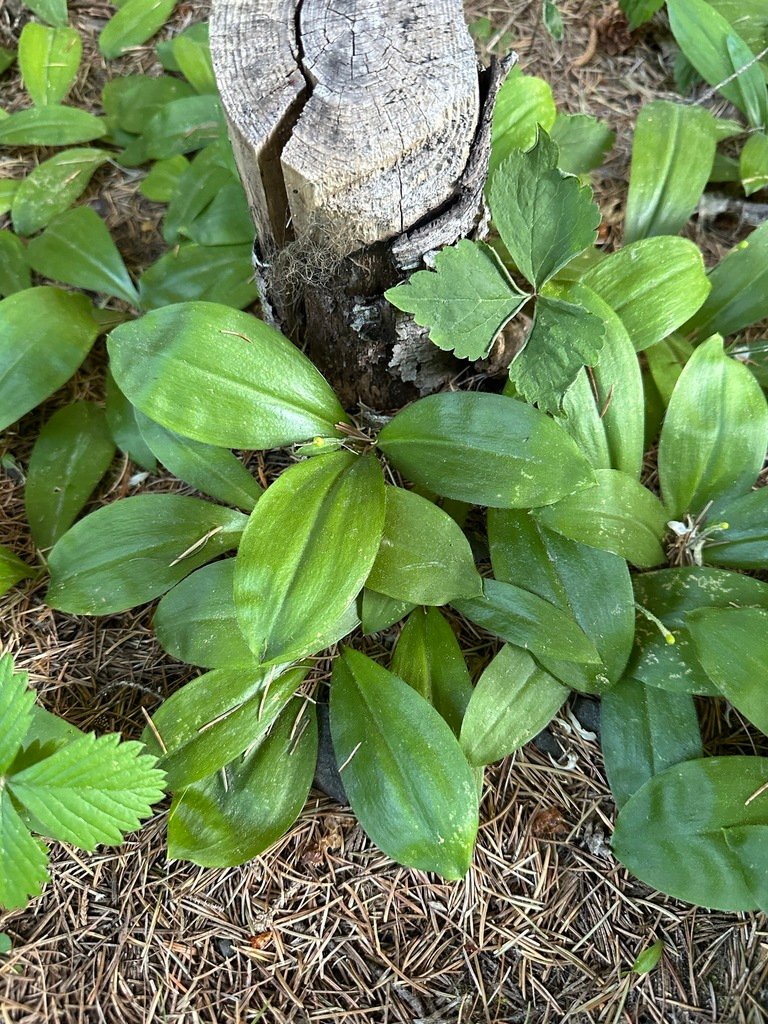
Bride’s bonnet, also called queen’s cup, is a small lily of cool conifer forests. Each plant has just two or three broad, shiny leaves near the ground and a short, hairy stalk that holds one white flower, now and then two. The six creamy white petal-like parts open into a wide, starry cup around long stamens.
After flowering, the bloom becomes a single round berry of deep, glossy blue, which explains another of its names, blue-bead lily. Varied thrushes and other fruit-eating birds take the berries, and grouse are reported to eat them too. People should leave them alone, since the berries may be poisonous.
The plant spreads by underground stems, so it often forms loose carpets of leaves, and a single plant can live 30 years or more. It favors moist, cool forest, the kind dominated by western redcedar, western hemlock and true firs, and it is most common between about 3,000 and 5,000 feet. It copes with light from deep shade to fairly open forest. On Mt. Hood trails, look for the flowers from late spring into summer and for the blue berries once the petals fall.
How to identify it
Look for two or three broad, glossy, oblong leaves, about 3 to 8 inches long, at the base of a short, hairy flower stalk roughly 6 to 10 inches tall. The single flower has six creamy white petal-like parts and long stamens. It ripens into one round, deep blue berry about a quarter to a third of an inch across.
Look-alikes
Pacific trillium also carries a single white flower, but it has three leaves in a whorl at the top of the stem and three petals instead of six.
Habitat
Moist conifer forest from the foothills to fairly high in the mountains, most often between about 3,000 and 5,000 feet. It favors cool, damp sites under western redcedar, western hemlock and true firs, in shade or partial sun.
Photos
Sightings in the forest
533 research-grade sightings in Mt. Hood National Forest on iNaturalist, most recently on October 2, 2026. See them on iNaturalist →