
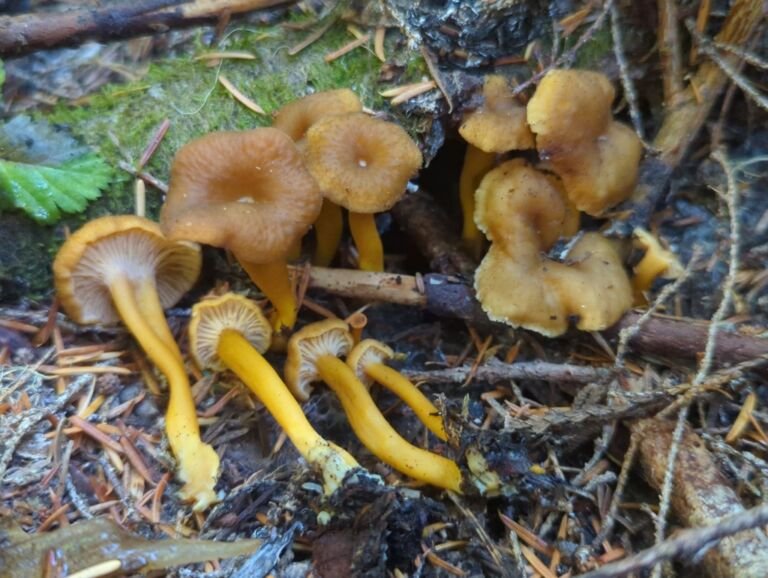
Yellowfoot is a small relative of the chanterelles that shows up when most other mushrooms are finished for the year. On the West Coast it fruits late, into winter and spring, often in groups or loose clusters in moss and on old, rotten logs. Its common names, yellowfoot and winter chanterelle, describe both its look and its timing.
The cap is brown, about an inch or two across, and soon becomes vase shaped, often with a hole opening in the center. Underneath, instead of true gills, it has forking, vein-like ridges that run down the stem and turn grayish with age. The stem is hollow, waxy to the touch and bright yellow when young, fading to dull yellow or brownish.
Yellowfoot is mycorrhizal, partnering with the roots of conifers such as western hemlock and Douglas-fir. One study in the region found it growing from well-decayed wood nearly nine times out of ten. DNA work suggests that the West Coast yellowfoot is a different species from the one in Europe, and it still lacks a formal name, so the scientific name used here may change.
How to identify it
Cap 1 to 2 inches wide, dark yellowish brown, becoming vase shaped and often perforated in the center. The underside has forked, blunt, vein-like false gills that run down the stem and turn gray. The stem is hollow, waxy and bright yellow when young. Spore print white to yellowish.
Look-alikes
Pacific golden chanterelle is larger and fleshier, with an orange-yellow cap that does not open in the center and a solid, tapering stem.
Habitat
Moss and well-rotted, moss-covered logs in moist conifer forest, especially with western hemlock and Douglas-fir. It fruits late in the season, into winter and spring.
Photos
Sightings in the forest
86 research-grade sightings in Mt. Hood National Forest on iNaturalist, most recently on August 27, 2026. See them on iNaturalist →