
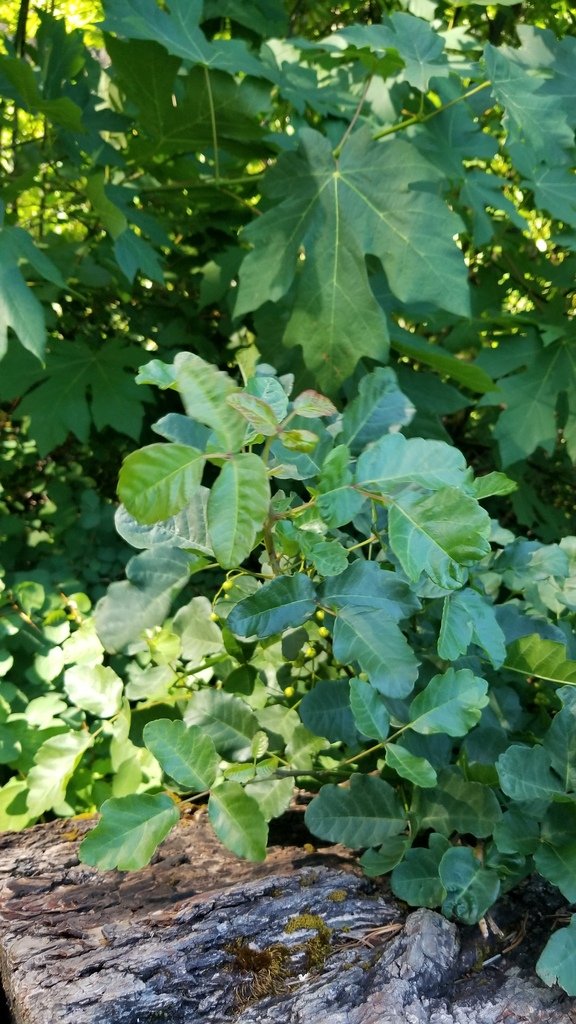
Pacific poison oak is a native member of the sumac family. It grows as a many-stemmed shrub, a low ground cover or a woody vine that climbs trees with small aerial roots. Its leaflets come in threes and are lobed or toothed in a way that recalls oak leaves, though the shape varies even on one plant. New leaves are often reddish, summer leaves are green and may be glossy or dull, and in fall they turn shiny red before dropping.
Every part of the plant except the pollen contains urushiol, an oily resin that causes an allergic rash in most adults. The oil is present all year, including on bare winter stems, and it travels on clothing, tools, firewood and pets. Smoke from burning plants carries it too and can cause serious lung reactions.
For wildlife it is food and cover. Birds eat the small whitish berries and spread the seeds, and black-tailed deer browse the leaves. Pets can react to the oil, but wild animals do not. After a fire it sprouts back vigorously from its root crown and rhizomes.
Around Mt. Hood it belongs to warm, low-elevation slopes, open woods and oak savanna west of the Cascades and in the Columbia River Gorge, not the high forest.
How to identify it
Leaves alternate along the stem, each split into three leaflets (sometimes five) about 1 to 6 inches long, with rounded, irregular lobes like small oak leaves. Leaves may be reddish when young, green in summer and bright red in fall. Small greenish-white flower clusters in spring become glossy, whitish berries. It may be an upright shrub, a low mat or a vine climbing a tree.
Look-alikes
Western poison-ivy, which replaces it east of the Cascades and hybridizes with it in the Columbia River Gorge, has leaflets with sharply pointed tips, while Pacific poison oak's are rounder and more irregular. Treat both as off limits.
Habitat
Open woods, woodland edges, oak savanna, clearings, stream banks and rocky canyons at low elevations west of the Cascades and in the Columbia River Gorge. It is a plant of the warm lowlands and foothills and does not reach the high country.
Photos
Sightings in the forest
542 research-grade sightings in Mt. Hood National Forest on iNaturalist, most recently on October 22, 2026. See them on iNaturalist →