
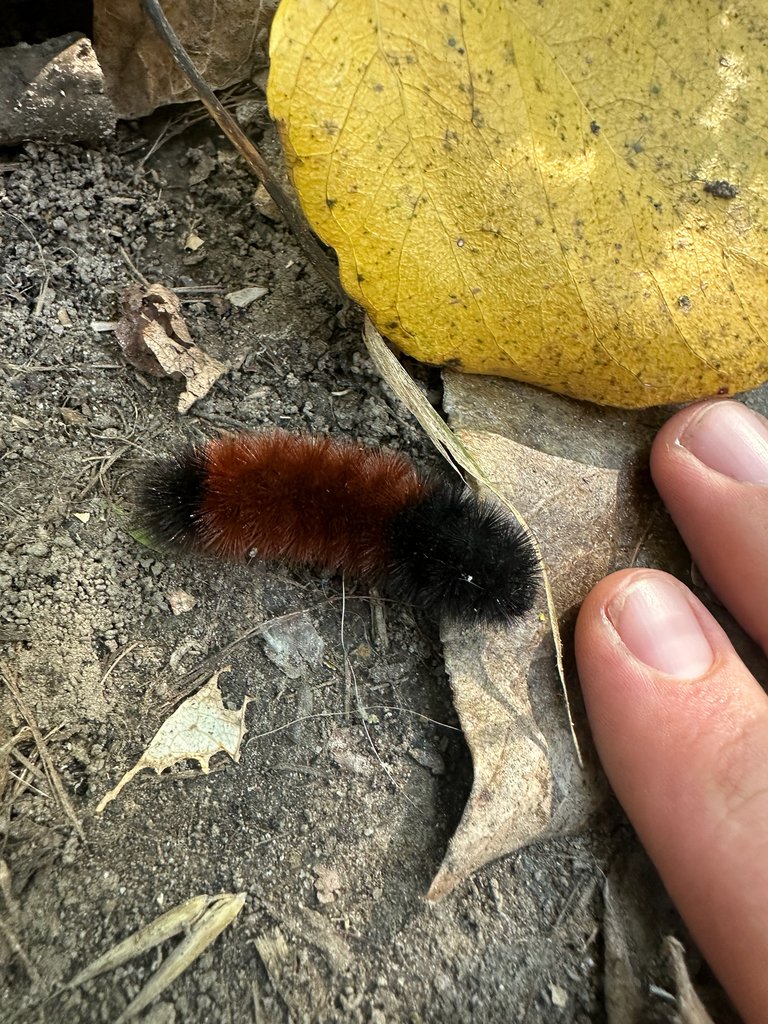
Most people know the Isabella tiger moth as a caterpillar. The banded woolly bear is covered in dense, stiff bristles, black at both ends with a rusty red band through the middle, and it curls into a tight ball when disturbed. In autumn woolly bears are often seen crossing roads and trails, looking for shelter under bark, logs or leaf litter. They spend the winter as caterpillars, able to withstand freezing, then feed a little more in spring before spinning a cocoon from their own hairs.
Folklore says a wide rusty band means a mild winter. The Missouri Department of Conservation says there is nothing to it: band widths change with the caterpillar’s age, the weather it grew up in and its genes, and older caterpillars simply have wider rusty bands.
The caterpillars are generalists that eat many low plants, including plantain, dandelion, dock, clover and grasses. The adult moth is handsome in a quiet way, with plain orange-brown forewings marked by faint lines and small black spots, and orange to pinkish hindwings. It flies at night and comes readily to lights.
In the Northwest it is most common in moist, lower-elevation places west of the Cascades, such as wet meadows, grasslands and mixed hardwood forest, and it also reaches mixed forest higher in the mountains.
How to identify it
Adults have a wingspan of about 1.75 to 2.25 inches, with plain orange-brown to tan forewings marked by faint lines and small black spots along the veins, orange to pinkish hindwings with black spots and an orange abdomen with rows of black spots. The caterpillar is densely covered in stiff bristles, black at both ends and rusty red in the middle.
Look-alikes
Adults are distinctive and unlikely to be confused with other moths in the region. Some other fuzzy caterpillars can sting, so if you are not sure what you have found, don't handle it.
Habitat
Moist, lower-elevation habitats such as wet meadows, grasslands and mixed hardwood forest west of the Cascades, with some in mixed forest at higher elevations. East of the Cascades it is found mainly in moist streamside meadows.
Photos
Sightings in the forest
239 research-grade sightings in Mt. Hood National Forest on iNaturalist, most recently on November 3, 2026. See them on iNaturalist →