
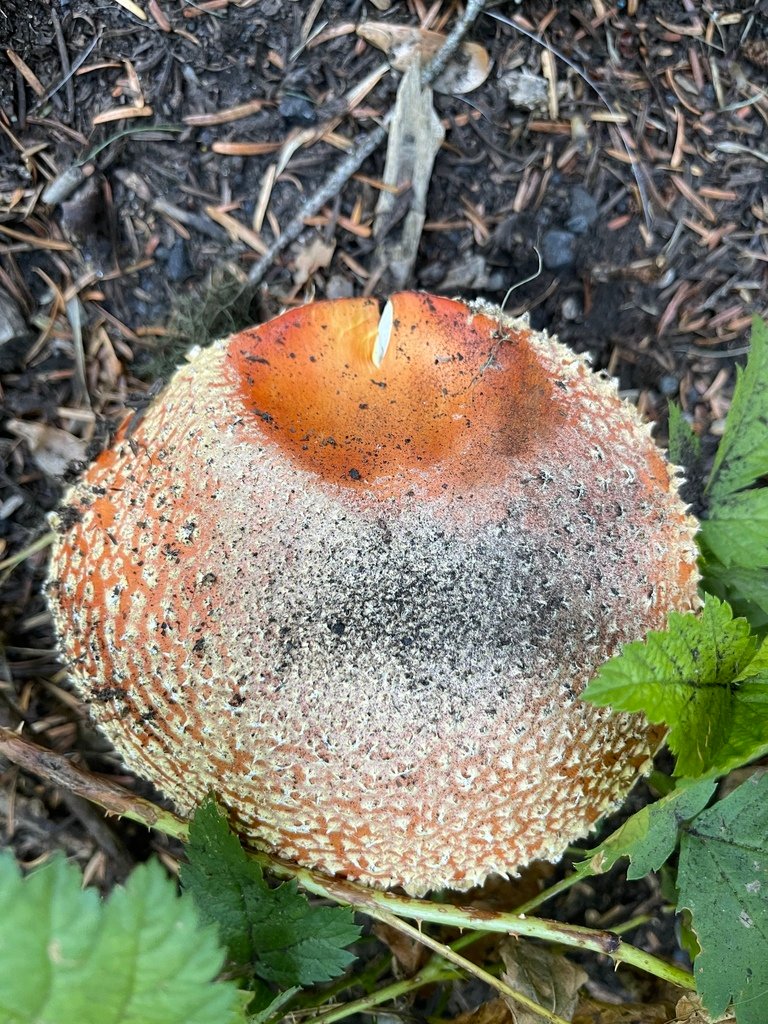
Fly agaric is the classic red mushroom with white spots, and in late summer and fall it turns up on the forest floor around Mt. Hood. The cap is deep to bright red, sometimes fading to orange or pale yellow with age, and it is scattered with cottony warts that start out yellowish and soon turn white. Those warts are leftovers of a universal veil, a skin that wraps the whole young mushroom as it pushes out of the ground.
Fly agaric is a mycorrhizal partner of trees. Its fungal threads join the roots of conifers and hardwoods and supply them with water, phosphorus and nitrogen in exchange for sugars the trees make through photosynthesis. The mushrooms you see are only the fruiting bodies of that hidden network, which is why they appear singly, in scattered groups, or sometimes in large rings on the forest floor.
The form found in the Pacific Northwest and Rocky Mountains is usually called Amanita muscaria var. flavivolvata, for its yellowish warts, and mycologists expect the naming of this group to keep changing.
Fly agaric is poisonous, and its genus also includes deadly species, so it is a mushroom to admire and photograph and then leave where it grows.
How to identify it
A red to orange-red cap covered with cottony warts that are yellowish at first and soon white. Gills are white and free or barely attached, the white stem carries a high, skirt-like ring, and the swollen base is ringed with concentric bands of veil tissue. Spore print white.
Look-alikes
The panther amanita has a brown cap and usually a collar-like rim on its bulb instead of concentric rings. Amanita aprica, common in spring, has a yellow to orange cap with a frosty white coating rather than distinct warts. Both are poisonous.
Habitat
Forest floor under conifers and hardwoods, where it forms partnerships with tree roots. It appears singly, in scattered groups or in rings, mostly in late summer and fall.
Photos
Sightings in the forest
228 research-grade sightings in Mt. Hood National Forest on iNaturalist, most recently on October 23, 2026. See them on iNaturalist →