
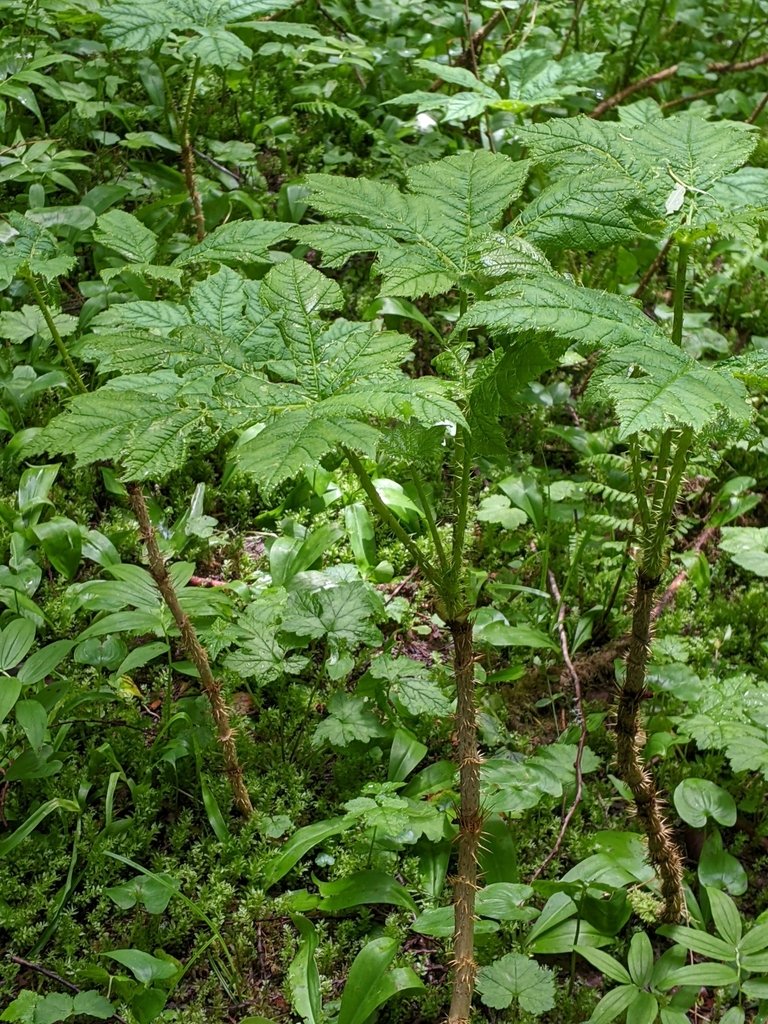
Devil’s club earns its name. This native shrub grows 3 to 10 feet tall on thick, mostly unbranched stems bristling with yellowish spines, and the spines continue onto the leaf stalks and the veins of its enormous leaves. Those leaves can be more than a foot across, lobed like a maple, and together they form a canopy that makes a streamside thicket look almost tropical.
From late spring into summer a spike of small greenish-white flowers rises above the leaves, visited by bumblebees and other bees. By midsummer it turns into a cluster of flattened, bright red berries. Bears eat the berries in large amounts and spread the seeds in their droppings, and deer and elk browse the plant lightly.
Devil’s club is a relative of ginseng and has a strong scent much like it. It has long been important to many Northwest Native peoples, who used it for fishing lures and hooks, tattoo ink and spiritual cleansing.
It needs wet, shaded ground, so it gathers along creeks, springs and seeps under the conifers. Its broad leaves also shade streams, helping keep the water cool for young salmon and trout.
How to identify it
A thicket-forming shrub with thick, mostly unbranched stems densely covered in yellowish spines up to about 0.4 inch long. Leaves are huge, palmately lobed, heart-shaped at the base and irregularly toothed, with spines along the stalks and veins. Small greenish-white flowers grow in an upright spike that becomes a cluster of flattened, bright red berries.
Habitat
Moist to wet, shaded forest with poorly drained soil, especially beside springs, seeps and streams. In Oregon it is reported from about 1,300 to 4,600 feet, so on Mt. Hood it belongs to the lower and middle-elevation forests.
Photos
Sightings in the forest
625 research-grade sightings in Mt. Hood National Forest on iNaturalist, most recently on October 28, 2026. See them on iNaturalist →