
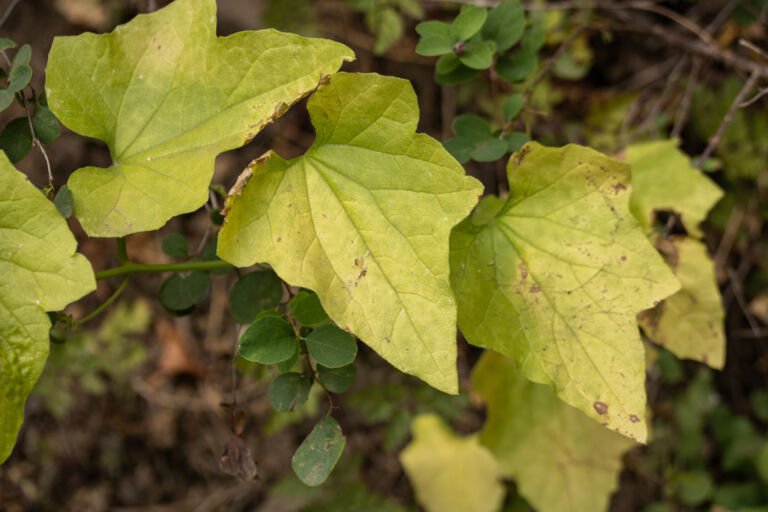
Coastal manroot is a wild relative of cucumbers and squash, and it grows like one. Each spring, leafy stems rise from a buried root, trail across the ground or climb over shrubs with coiling tendrils, and spread broad, lobed leaves. Small white flowers with five flaring lobes follow, the male ones in short clusters and the female ones mostly single at the base of those clusters.
The female flowers become green, striped, gourd-like fruits up to about three inches long, covered in soft, flexible prickles. Inside are a few large seeds. After fruiting, the vines die back to the ground, and the plant waits out the dry season underground.
That root is the plant’s secret. It is a tuber that can grow as big and heavy as a person, up to about 100 kilograms, and often reaches more than five feet deep, which explains the name manroot. Plants can live for more than a century. The genus name Marah comes from the Hebrew word for bitter, a good fit, since every part of the plant contains bitter compounds called cucurbitacins that help keep grazing animals away.
Look for it from spring into early summer at lower elevations, in open woods, thickets, fields and forest openings, including the Columbia River Gorge.
How to identify it
A herbaceous vine with coiling tendrils and alternate, broad leaves with a heart-shaped base and several shallow lobes. Small white, star-shaped flowers, usually five-lobed. Fruit is a green, inflated, gourd-like capsule 1 to 3 inches long, covered in soft prickles and often beaked at the tip.
Look-alikes
Balsam apple, also called wild cucumber (Echinocystis lobata), is a similar vine that is uncommon in Oregon. Its leaves have five lobes that each taper to a single sharp point, like a star, while manroot's lobes have several points, giving the leaf a rounder outline.
Habitat
Low-elevation fields, thickets, open woodlands and forest openings, often among oaks or where conifers mix with broadleaf trees, and in riparian spots along the Columbia River drainage. Around Mt. Hood it is a plant of the lower valleys and the Gorge, not the high country.
Photos
Sightings in the forest
578 research-grade sightings in Mt. Hood National Forest on iNaturalist, most recently on September 6, 2026. See them on iNaturalist →