
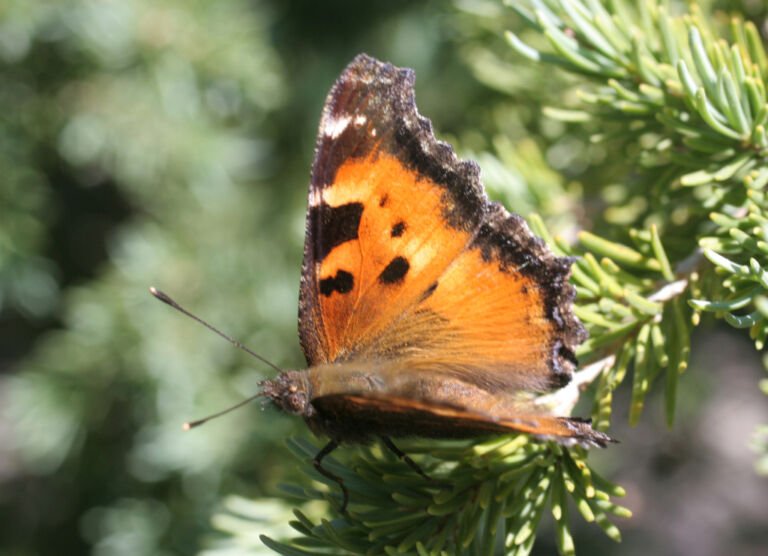
The California tortoiseshell is a medium-sized butterfly with orange-brown wings, bold black spots and dark borders on the upper side. When it folds its wings, it shows a mottled brown underside that looks like a dead leaf, so a resting butterfly can all but vanish against a tree trunk.
Its caterpillars feed on wild lilacs in the genus Ceanothus, including snowbrush and tobaccobrush in the mountains. Adults spend the winter hibernating, wake in late winter to lay eggs on fresh growth in the foothills, and the next generation heads uphill in early summer to breed again on high-country Ceanothus. During hot, dry midsummer the butterflies go quiet, sometimes gathering in large numbers on peaks and high slopes, then move back downhill in fall to find places to spend the winter.
What makes this butterfly famous is its boom years. Its numbers swing widely and unpredictably. In some summers it is no more common than other butterflies, while in others it appears in huge swarms, its spiny black and yellow caterpillars strip whole hillsides of Ceanothus, and the adults crowd onto puddles and flowers. In a boom year, drive slowly on mountain roads so the butterflies can drift over your car.
How to identify it
Wingspan about 1.25 to 2.75 inches. Above, the wings are orange-brown, marked with big black spots and edged with dark borders. The underside is dark, mottled brown like a dead leaf, darker toward the body, with no silver spot in the middle of the hindwing.
Look-alikes
Milbert's tortoiseshell is mostly black above with a wide orange band that turns yellow on its inner edge, rather than orange with black spots.
Habitat
Forest clearings and edges, brushy slopes and mountain terrain up to and above treeline, wherever its Ceanothus host plants grow nearby. Adults also visit canyons, streamsides and gardens.
Photos
Sightings in the forest
506 research-grade sightings in Mt. Hood National Forest on iNaturalist, most recently on October 3, 2026. See them on iNaturalist →