
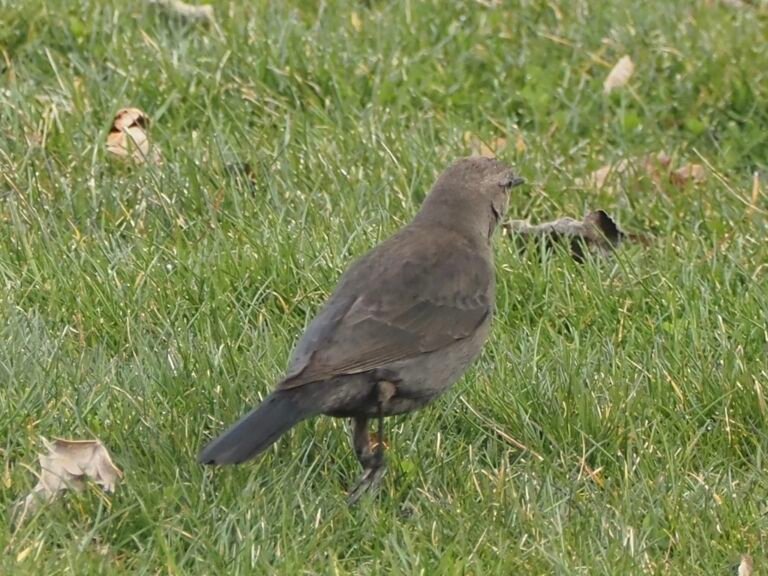
Brewer’s Blackbird is the glossy black bird strutting across lawns, parking lots and meadow edges, jerking its head forward with each step. Males shine iridescent black with a purplish sheen on the head and pale yellow eyes. Females are plain grayish brown with dark eyes.
These blackbirds walk on the ground and pick most of their food from it: grasshoppers, crickets, beetles, caterpillars and other insects, plus spiders, snails, weed seeds, spilled grain and summer berries. They sometimes wade into very shallow water or snap insects out of the air. Outside the nesting season they forage in flocks, sometimes mixed with other blackbirds.
Brewer’s Blackbirds often nest in loose colonies of a couple dozen pairs. The female builds a bulky cup of twigs, grass and pine needles, usually in a tree but sometimes in a shrub or on the ground in tall grass. Both parents feed the young, which leave the nest about two weeks after hatching.
This is a bird of open country, so around Mt. Hood look for it where the forest opens up: around lakes, campgrounds, trailheads and meadows, and in the farm valleys below the forest.
How to identify it
A robin-sized blackbird, about 8 to 10 inches long. Males are glossy black with a purplish sheen on the head and pale yellow to whitish eyes; females are dull grayish brown with dark eyes. It walks on the ground with a forward jerk of the head.
Look-alikes
The Brown-headed Cowbird is a little smaller, and the Common Grackle has a noticeably longer tail.
Habitat
Open and semi-open country: meadows, fields, shrubby areas near water, streamside woods, parks, lawns and parking lots. In the national forest it sticks to openings, lakeshores and developed sites rather than closed forest.
Photos
Sightings in the forest
150 research-grade sightings in Mt. Hood National Forest on iNaturalist, most recently on October 20, 2026. See them on iNaturalist →