
The American Pika is a small, round, tailless relative of rabbits and hares that lives in the rock piles of Mt. Hood’s high country. It is not a rodent. Most people hear one before they see it: a short, high squeak or whistle from somewhere in a talus slope. Look carefully and you may spot a tan to gray ball of fur with round ears perched on a boulder.
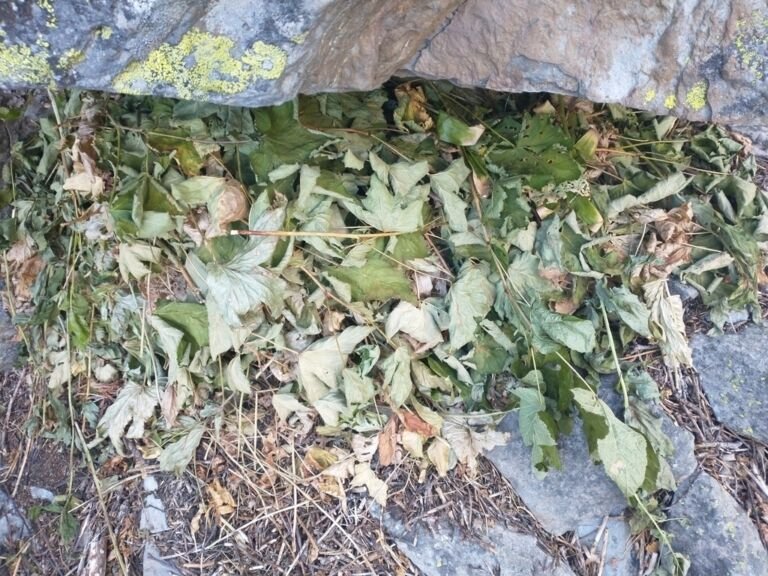
Pikas do not hibernate. Instead they spend the summer haying, clipping grasses and wildflowers and dragging them back to stash under rocks and in crevices. These haypiles feed the pika through the winter, when it travels between them through tunnels under the snow. A pile of drying plants tucked between boulders is the surest sign that pikas live nearby.
Pikas are sensitive to heat. Temperatures above about 78 degrees Fahrenheit can harm them, so they are most active in the cooler parts of the day and retreat into the cool spaces deep in the rocks. That sensitivity also leaves them vulnerable to a warming climate, and the Oregon Department of Fish and Wildlife lists the pika as an Oregon Conservation Strategy Species.
Talus slopes along high trails are the place to look and listen. Give pikas space, keep dogs out of the rocks, and leave their haypiles alone.
How to identify it
A small, round mammal about the size of a rat, tan to gray, with round ears, short legs, long whiskers and no visible tail. It sits on rocks in talus slopes and gives a short, high-pitched squeak or whistle.
Habitat
Talus slopes, boulder fields and rocky crevices with cool microclimates, close to plants it can harvest. In Oregon it lives in the Cascade Range and several eastern mountain ranges, mostly on subalpine and alpine rock slopes.
Photos
Sightings in the forest
161 research-grade sightings in Mt. Hood National Forest on iNaturalist, most recently on August 20, 2026. See them on iNaturalist →