
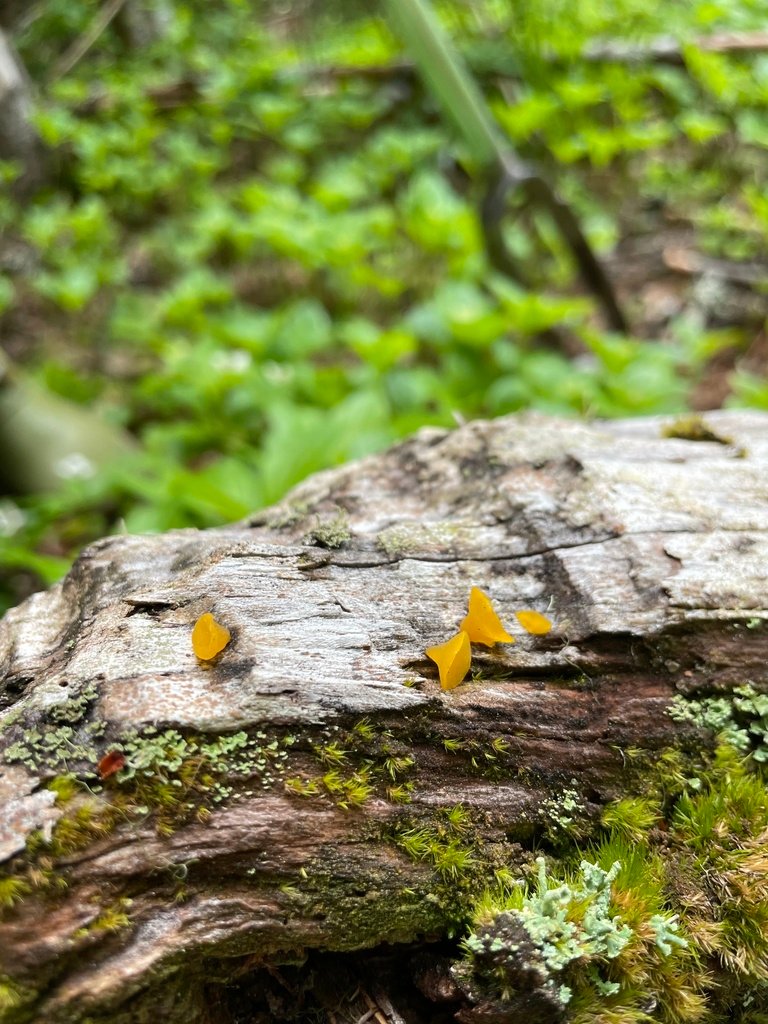
Alpine jelly cone is one of the early fungi on Mt. Hood each year. Soon after the snow pulls back from a fallen log, small, bright yellow-orange jellies push out of cracks in the bare, barkless wood, usually in clusters. Each one is shaped like a little spinning top or a shallow disc, with a clear upper surface and sometimes a short, cone-shaped base underneath.
They are small, mostly well under an inch across, and the flesh is gelatinous and softly rubbery. The surfaces are smooth and the color is about the same above and below, though the underside can be a little darker. There is no real stem and no noticeable smell.
Alpine jelly cone is a saprobe, meaning it feeds on dead wood rather than living trees, and it sticks to conifers. It fruits right after snowmelt, which puts it in spring at lower elevations and into summer higher up; mushroom experts have found it as long as six weeks after the snow was gone. It occurs throughout western North America from the Rocky Mountains west, and it has also been reported from South America and Europe.
Look for it on logs, stumps and old snags along trails where the snow has only recently melted. Its bright color makes it easy to spot against weathered gray wood.
How to identify it
Small, about 1/8 to 3/4 inch across, yellowish orange to orange-yellow, gelatinous and rubbery. Shaped like a top or shallow disc with a distinct upper surface, sometimes on a short, cone-shaped base. Grows in clusters from cracks in barkless conifer wood soon after snowmelt.
Look-alikes
Orange jelly fungi in the genus Dacrymyces grow on similar wood but usually form lobed, blob-like or brain-like masses with no distinct upper surface.
Habitat
Dead conifer wood without bark, such as logs, stumps and snags, in mountain forests. It fruits just after snowmelt: in spring at lower elevations and into summer at higher ones.
Photos
Sightings in the forest
91 research-grade sightings in Mt. Hood National Forest on iNaturalist, most recently on June 29, 2026. See them on iNaturalist →