
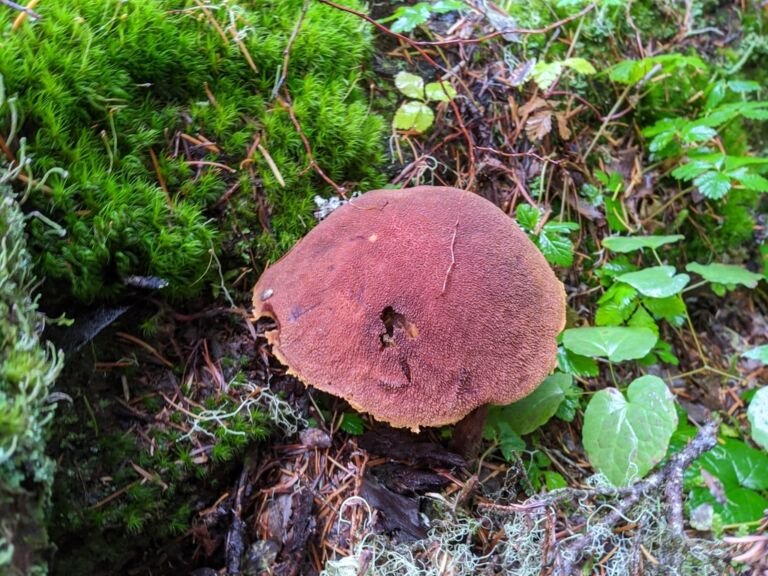
The admirable bolete is a big, handsome mushroom of Northwest hemlock forests. Its cap, often 7 to 14 cm across, is dark maroon to reddish brown, with a felty surface that turns finely scaly with age. Underneath, instead of gills, it has a spongy layer of pores that starts cream-yellow and turns yellowish green. The thick stem matches the cap in color, carries a raised net pattern near the top, and is often swollen toward the base.
This bolete usually fruits on well-rotted, moss-covered logs and stumps, especially of western hemlock, and sometimes on the ground nearby. It forms a partnership with the roots of living hemlocks, so its range closely follows western hemlock and, now and then, mountain hemlock. The flesh is pale to pinkish and does not turn blue when cut or bruised, a useful clue among boletes.
On Mt. Hood, look for it in moist hemlock and mixed conifer forest soon after the fall rains begin. It is widespread across western North America and its global status is Least Concern. Molds and insect larvae often attack it, so older specimens can look ragged.
How to identify it
Cap 7 to 14 cm, maroon-brown to dark reddish brown, felty to finely scaly. Pores cream-yellow aging to yellow-green, not bruising blue. Stem 7 to 14 cm, colored like the cap, netted at the top and swollen at the base. Usually on rotting hemlock wood.
Look-alikes
Albatrellus pes-caprae, a ground-dwelling polypore, has a similar brown, scaly cap, but its stem is usually off-center and its flesh is tough and leathery.
Habitat
Moist western hemlock forests, occasionally with mountain hemlock, from northern California to Alaska and from the southern Oregon Cascades northward. Fruits on well-decayed, mossy logs and stumps, sometimes on soil, after the fall rains.
Photos
Sightings in the forest
212 research-grade sightings in Mt. Hood National Forest on iNaturalist, most recently on November 8, 2026. See them on iNaturalist →